

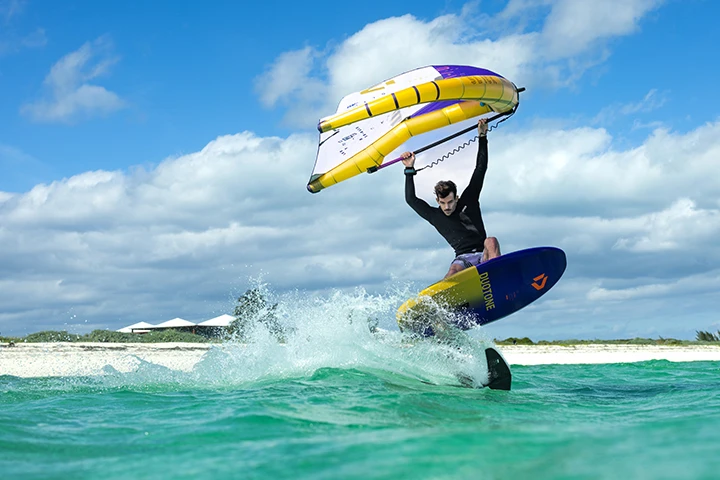

Hydrofoil technology has changed how water sports riders interact with ocean waves, open lakes, and coastal bays. By lifting the hull above the water, a foil board removes surface friction, allowing riders to move smoothly over chop with minimal effort. Finding the right board design expands what is possible across different water conditions and wind levels.
Finding the right equipment depends on where you ride, local wind conditions, and how you want to catch energy from the water. From wind-driven setups to flat-water dock launches, every riding style relies on specific board dimensions, volume distributions, and track placements.
The Rise of Modern Hydrofoil Disciplines
Foil boards function by using an underwater hydrofoil wing assembly mounted to the bottom of the hull via a rigid mast. As speed increases, the underwater wing generates lift, raising the board into the air.
Because friction drops dramatically once airborne, riders can maintain speed on small swells or light wind breezes that would stall a conventional board. The overall market has shifted from heavy multi-purpose shapes toward specialized board shapes designed for exact riding environments.
Riders generally focus on four primary disciplines:
- Wing Foiling: Powered by a lightweight handheld wing to harness wind energy.
- Downwind Foiling: Designed to catch open-ocean rolling swells over long distances.
- Surf or Prone Foiling: Paddled into ocean waves by hand, similar to traditional prone surfing.
- Pump or Dock Start Foiling: Self-propelled from a pier or bank using leg power.
Understanding structural differences across these categories makes selecting your board far simpler.
Wing Foiling Boards: Stability Meets Control
Wing foiling remains one of the fastest-growing water sports due to its accessibility across lakes and oceans. The rider holds an inflatable wing to catch the wind while standing on a specialized board.
Selecting a wing foiling board requires matching the board volume to your body weight. Beginners usually start on boards that offer 30 to 40 liters of flotation over their weight in kilograms. This extra buoyancy keeps the deck stable while kneeling and setting up the wing.
As skills grow, riders transition to smaller, compact boards with lower volume. Shorter lengths reduce swing weight, making high-speed turns and jumps responsive.
Key Advantages
- Wide Wind Range: Works in light winds up to strong gales.
- Rapid Skill Transfer: Short learning curve for anyone with basic board sport experience.
- Safety: Inflatable wings provide drag-free depower when letting go of the handles.
Main Challenges
- Gear Management: Requires carrying both a wing and a board setup to the beach.
- Sizing Progression: Riders outgrow large beginner boards quickly as their balance improves.
Downwind Foiling Boards: Long, Narrow, and Efficient
Downwind foiling represents a major shift in how riders tackle open ocean chop. Instead of relying on breaking waves or steady wind, downwind riders use long paddle strokes to catch deep-water ocean rollers.
A dedicated downwind foiling board features a long, narrow outline reminiscent of early displacement hulls. The narrow width cuts through surface water tension quickly, allowing the board to reach take-off speed with minimal paddle effort.
Design Trends in Downwind Shapes
- Increased Length: Boards ranging from 7’0″ to 8’6″ help build forward momentum.
- Narrow Widths: Racks measuring 18 to 22 inches wide cut water displacement resistance.
- Chiseled Tails and Pin Tails: Allow smooth water release during fast paddling.
Key Advantages
- Unmatched Glide: Enables long distance ocean trips without needing continuous wind.
- Light Wind Winging: The narrow shape lets wing foilers take off in minimal breeze.
Main Challenges
- Side-to-Side Instability: Narrow decks require strong balance while standing still.
- Length Management: Longer boards can feel bulky during steep turns on smaller waves.
Surf and Prone Foiling Boards: Pure Wave Connection
For riders focused purely on wave riding, prone foil boards offer a direct feel underfoot. Prone foilers paddle out on their stomach, catch an unbreaking swell, and pop up onto their feet just as the hydrofoil lifts.
A high-performance surf foiling board is kept as small as possible. Shorter lengths (ranging from 4’0″ to 5’2″) keep the nose light, allowing tight carves along wave faces.
Key Advantages
- Continuous Wave Rides: Connect multiple wave lines by pumping back out to the lineup.
- Clean Setup: No sails, wings, or paddles needed once on the wave face.
Main Challenges
- Physical Demand: Paddling out through shorebreak requires strong upper body stamina.
- Strict Placement: Precise foot positioning is necessary to prevent immediate nose-dives.
Pump and Dock Start Foiling: Flat-Water Freedom
Dock starting removes the need for wind, waves, or ocean access entirely. Riders start from a wooden dock or pontoon, run along the platform, throw the board onto the surface, and jump directly onto the deck.
A specialized pump foiling board is built with ultra-minimal dimensions. Since these boards do not need to float a static rider, volume is reduced to save weight.
Board Construction Characteristics
- Compact Footprint: Often between 3’0″ and 4’0″ long to remove swing mass.
- Rigid Core: Carbon fiber layups ensure energy transfers straight into the hydrofoil mast.
- Flat Decks: Flat traction pads give instant feedback for rapid foot adjustments.
Key Advantages
- Ride Anywhere: Can be used on inland lakes, canals, and calm harbors.
- No Weather Dependence: Does not rely on wind speed or swell forecasts.
Main Challenges
- High Fitness Requirement: Continuous pumping demands intense cardio and leg effort.
- Strict Launch Timing: Misplacing your first step during a dock jump results in a wet crash.
Essential Board Features to Evaluate Before Purchase
When selecting a foil board, focus on construction materials and hardware configuration.
Track System Quality
Ensure the bottom of the board includes dual 10-inch US box tracks. Twin tracks allow you to slide the mast forward or backward, fine-tuning lift based on your weight and foil size.
Core Construction
Solid epoxy or carbon fiber boards provide stiff energy transfer, which improves pitch control. If portability is a priority, inflatable foil boards built with woven drop-stitch and solid carbon bottom plates offer a durable alternative.
Handle Placement
A bottom-mounted carrying handle makes carrying the board with the hydrofoil mast attached far more manageable on long walks down to the water edge.
Final Thoughts
Foiling continues to reshape how water sports lovers view local waterways. Whether you choose the wind-driven speed of wing foiling, the long ocean glides of downwind shapes, or the flat-water challenge of dock starting, finding the right board profile sets the foundation for progression.